
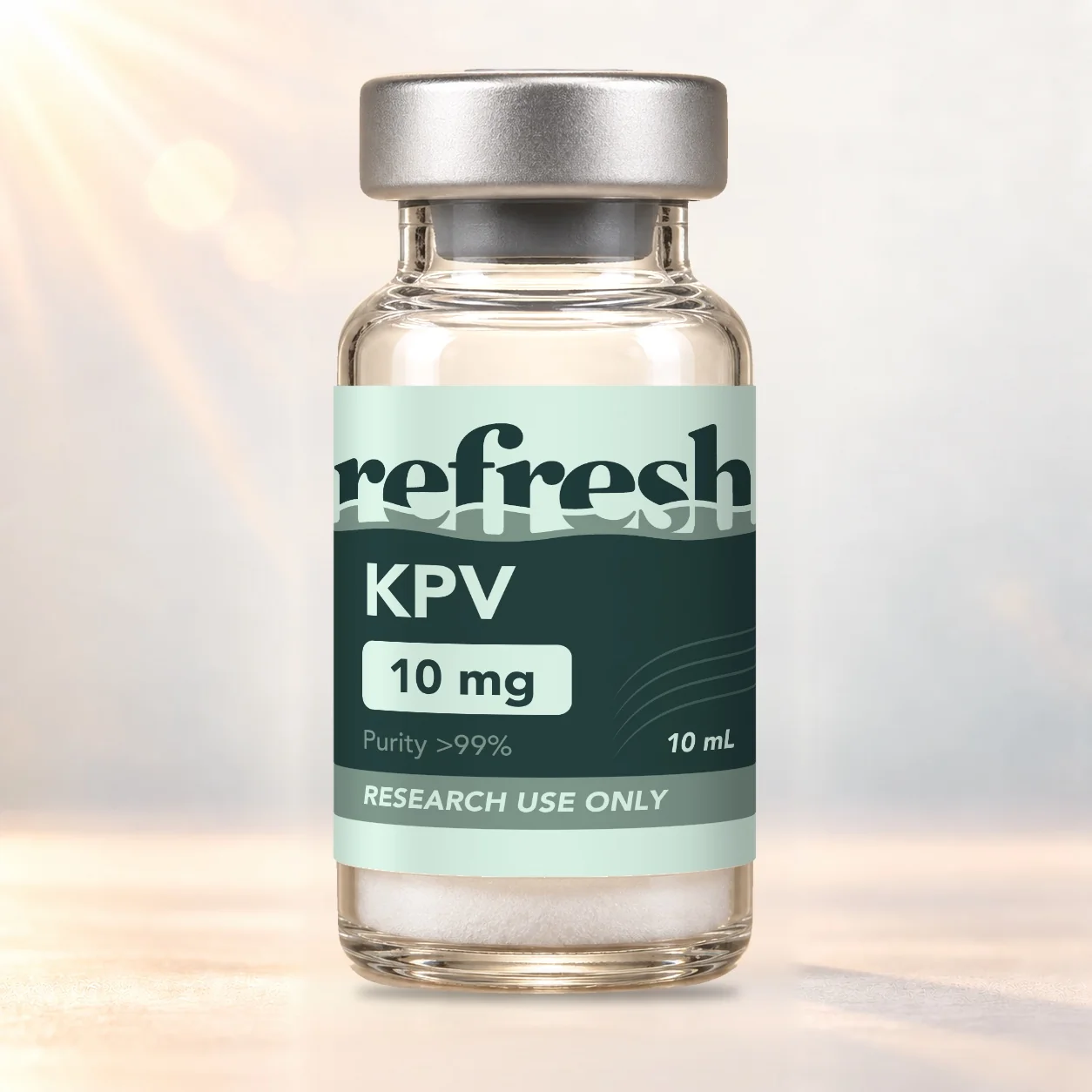
KPV Peptide Vial
$54.99$54.99 $46.74RESEARCH15 applied
KPV peptide for sale in a 10 mg lyophilized vial: the tripeptide Lys-Pro-Val taken from the C-terminus of alpha-MSH, sourced for laboratory research on inflammatory signaling in cell and animal models.
Researchers also bought
-
 Peptide Vials
5-Amino-1MQ Vial
50mg | 10mg Price range: $59.99 through $89.99Price range: $59.99 through $89.99Price range: $50.99 through $76.49RESEARCH15 applied Select options This product has multiple variants. The options may be chosen on the product page -
 Peptide Vials
MOTS-c Peptide Vial
40mg | 10mg Price range: $49.99 through $99.99Price range: $49.99 through $99.99Price range: $42.49 through $84.99RESEARCH15 applied Select options This product has multiple variants. The options may be chosen on the product page -
 Peptide Vials
CJC-1295 No DAC (Mod GRF 1-29) Vial
10mg | 5mg Price range: $39.99 through $59.99Price range: $39.99 through $59.99Price range: $33.99 through $50.99RESEARCH15 applied Select options This product has multiple variants. The options may be chosen on the product page
What is KPV?
Alpha-melanocyte-stimulating hormone (alpha-MSH) is a 13-residue peptide best known for its role in pigmentation, but researchers have studied it just as closely for its influence on inflammation. In the course of that work, they found that the last three residues, lysine, proline and valine, keep a meaningful share of the anti-inflammatory activity seen in laboratory models. That tripeptide is KPV.
How KPV differs from alpha-MSH
Unlike full-length alpha-MSH, KPV is not thought to act mainly through the melanocortin receptors that drive pigmentation. Research has instead suggested it may enter cells and act on inflammatory signaling directly, including the NF-kappaB pathway. Some studies have proposed uptake through the PepT1 peptide transporter, which is expressed in intestinal cells. Those mechanistic questions are still being explored.
KPV peptide research
Most published work on KPV uses cell culture and rodent models. Researchers have examined it in models of intestinal inflammation such as experimental colitis, in skin and keratinocyte studies, and in work measuring the release of inflammatory cytokines. All of this is preclinical research describing what scientists have tested.
KPV 10 mg vial details
- Sequence: Lys-Pro-Val
- Origin: C-terminal tripeptide of alpha-MSH (residues 11-13)
- Labeled quantity: 10 mg per vial
- Supplied as: freeze-dried solid, sealed vial
KPV vs the KLOW blend
KPV is also one of the four peptides in our KLOW blend vial, where it is paired with GHK-Cu, BPC-157 and TB-500. Labs studying KLOW often keep the single KPV vial on hand as a comparison.
A useful size for a small peptide
At only three residues, KPV has a very low molecular weight compared with most peptides in our range, so a 10 mg vial contains a large number of molecules. That is worth factoring in when planning molar concentrations for cell-based work.
Unopened vials are usually stored cold and dry until a lab is ready to reconstitute them.
Buy KPV peptide: 10 mg vial
Refresh Research sells KPV as a 10 mg lyophilized powder in a sealed glass vial.
- Because KPV is only three residues long, a 10 mg vial contains far more molecules than the same mass of a larger peptide.
- Ships as a dry powder from the USA. Store unopened vials at −20 °C once received; bacteriostatic water for reconstitution is sold separately.
- KPV is also one of the four peptides in our KLOW blend vial.
- Volume savings apply automatically when you order two or three vials.
KPV vs BPC-157 and GHK-Cu
| KPV | BPC-157 | GHK-Cu | |
|---|---|---|---|
| Size | 3 residues (Lys-Pro-Val) | 15 residues | 3 residues bound to copper |
| Origin | C-terminal end of alpha-MSH | Sequence from a gastric-juice protein | Found naturally in human plasma |
| Main research focus | Inflammatory signalling (NF-kappaB) and gut models | Tissue repair models | Skin and connective-tissue biology |
| Included in the KLOW blend | Yes | Yes | Yes |
| Formats here | 10 mg vial | Vials, capsules, spray | Vials, capsules |
References
- Dalmasso G, et al. PepT1-mediated tripeptide KPV uptake reduces intestinal inflammation. Gastroenterology. 2008;134(1):166-178. https://pubmed.ncbi.nlm.nih.gov/18061177/
These publications provide research context. They are not tests of Refresh Research products.
KPV certificate of analysis
Available COA / Lab Reports describe the samples and lots printed in each document. A supplier report does not verify a different Refresh Research stock lot without a documented match. Compare the compound, format, strength, and lot before relying on a report.
Laboratory research use only.
Product specifications
- CAS number
- 67727-97-3
- Molecular weight
- ≈342.4 g/mol
Keep unopened dry material at −20 °C for long-term storage, protected from light and moisture, unless the supplied label specifies otherwise. After preparing a solution, follow the lot-specific instructions and your validated laboratory protocol.
These reports describe the samples and lots printed in each document; they do not independently verify a different Refresh Research lot. Compare the compound, format, quantity, and lot with your label.
KPV 10mg
Related products
-
Peptide Vials
CJC-1295 No DAC (Mod GRF 1-29) Vial
10mg | 5mg Price range: $39.99 through $59.99Price range: $39.99 through $59.99Price range: $33.99 through $50.99RESEARCH15 applied Select options This product has multiple variants. The options may be chosen on the product page -
Peptide Vials
BPC-157 + TB-500 Blend Vial (Wolverine Stack)
20mg | 10mg Price range: $59.99 through $89.99Price range: $59.99 through $89.99Price range: $50.99 through $76.49RESEARCH15 applied Select options This product has multiple variants. The options may be chosen on the product page -
Peptide Vials
Epithalon (Epitalon) Peptide Vial
50mg | 10mg Price range: $49.99 through $94.99Price range: $49.99 through $94.99Price range: $42.49 through $80.74RESEARCH15 applied Select options This product has multiple variants. The options may be chosen on the product page -
Peptide Vials
MOTS-c Peptide Vial
40mg | 10mg Price range: $49.99 through $99.99Price range: $49.99 through $99.99Price range: $42.49 through $84.99RESEARCH15 applied Select options This product has multiple variants. The options may be chosen on the product page